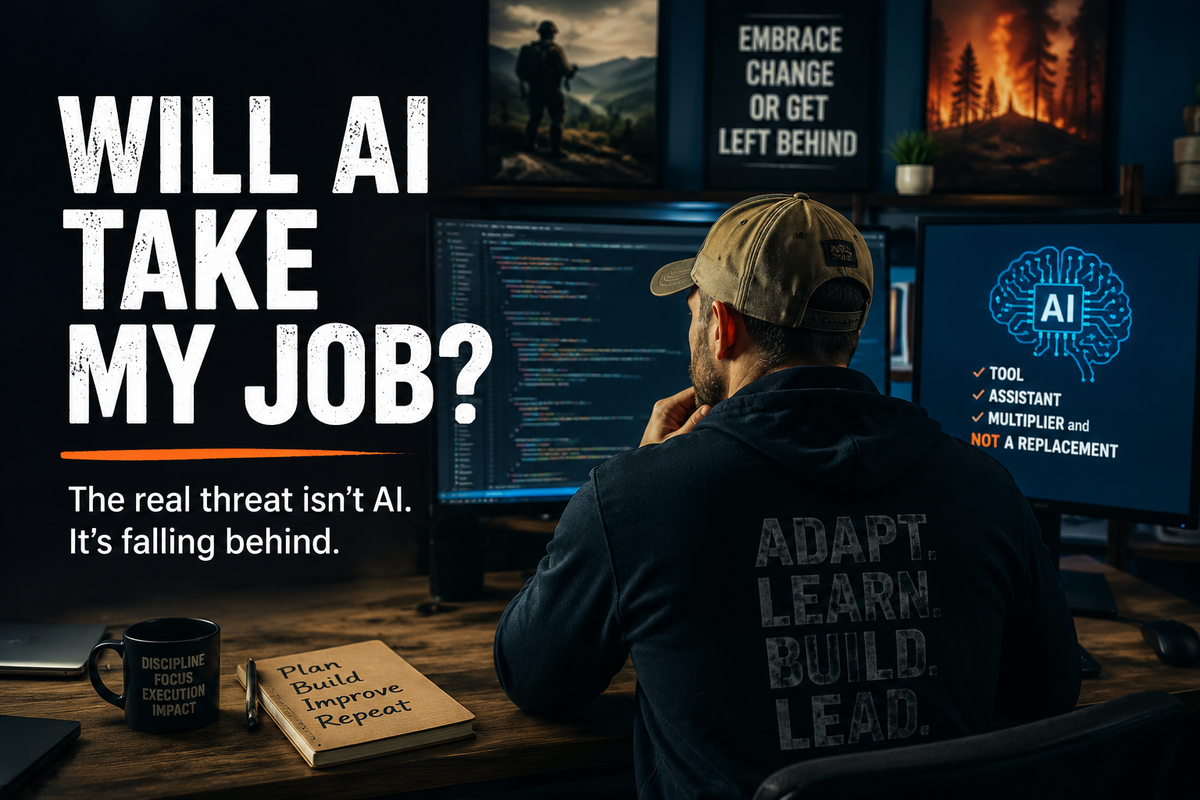
Will AI Take My Job?

Artificial Intelligence has become one of the biggest topics of discussion in education, the workforce, and even around the dinner table. “Will AI take my job?” is one of the most common questions I hear from classmates, coworkers, friends, and family.
So, what is the answer?
I am a software developer, and I use AI in my work every day. I use it to help write code, troubleshoot problems, brainstorm ideas, and accelerate development. I also build AI-powered features into projects that help end users do their jobs more effectively.
Do I think AI will eventually become my replacement?
The short answer is no.
In fact, I don’t believe AI will take my job. Instead, I believe it will take yours.
Now before you get offended, hear me out.
There are really two types of people in today’s workforce: those who misunderstand artificial intelligence and those who learn how to leverage it. Throughout history, every major technological advancement has created fear. When calculators became common, people argued they would ruin mathematics. When computers entered the workplace, people worried they would eliminate office jobs. When the internet arrived, entire industries resisted it.
The technology wasn’t what made people obsolete. Refusing to adapt was.
Mathematicians didn’t disappear because calculators were invented. They became more productive. Engineers didn’t stop existing because computers arrived. They became more capable. The people who embraced the new tools gained an advantage over those who refused to use them.
AI is simply the modern version of that same story.
A developer using AI can often solve problems faster than one who refuses to use it. A marketer can create content more efficiently. An analyst can process information more quickly. A business owner can automate tasks that once consumed hours of their day.
The workforce is not being divided between humans and machines. It is being divided between people who know how to use AI and people who don’t.
Will there be fewer people needed for certain jobs in the future? Probably. It may take fewer software developers to write the same amount of code. It may take fewer analysts to process the same amount of data. It may take fewer content creators to produce the same volume of work.
But the people who understand the tools will still be needed. In many cases, they’ll become more valuable than ever.
The individuals most at risk are not the ones learning AI. They are the ones pretending it doesn’t matter.
Technology has always rewarded adaptability. Artificial intelligence is no different. The people willing to learn, experiment, and grow alongside these tools will find new opportunities. The people who cling to old methods simply because they’re comfortable may find themselves struggling to keep up.
As for me, I plan to be on the side that learns.
AI may change the way I work. It may change the tools I use. It may even change what my job looks like ten years from now.
But if history has taught us anything, it’s that the future belongs to those who adapt.
I don’t plan on being left behind.